
What is the Anthropocene and the AWG?
What is the Anthropocene? – current definition and status
- The Anthropocene is a term widely used since its coining by Paul Crutzen and Eugene Stoermer in 2000 to denote the present interval of geological time, in which many conditions and processes at the Earth’s surface are profoundly altered by human impacts. Its central meaning is that those impacts, which became sharply amplified in the mid-20th century Great Acceleration of population, industrialization, globalization, energy consumption, and waste production took the Earth system out of the state typical of the Holocene Epoch of post-glacial time – and hence into a new epoch, the Anthropocene.
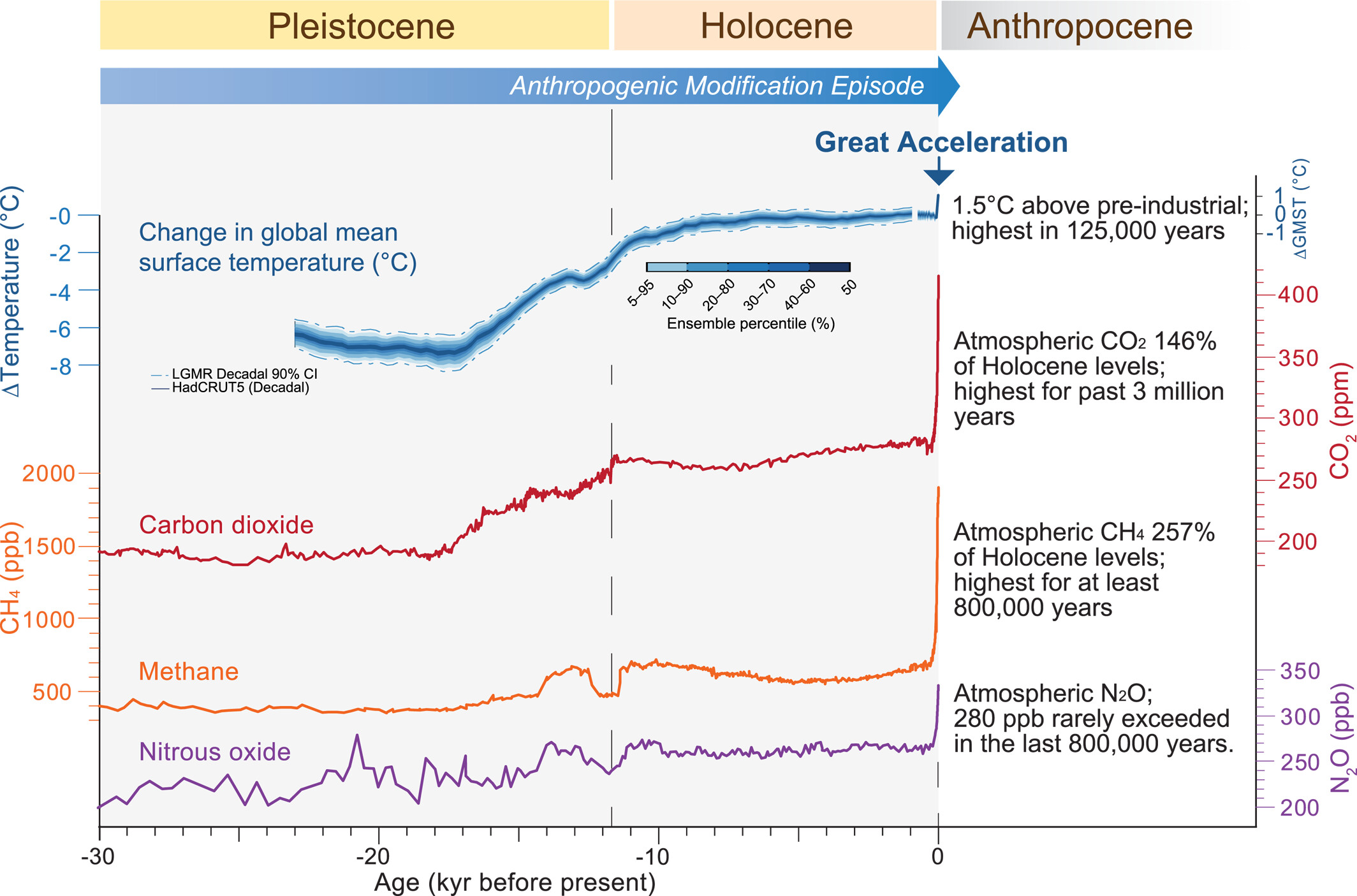
- The level proposed for the Anthropocene’s beginning is dated to 1952, marked by the near-instantaneous global dissemination of plutonium and other artificial radionuclides, when atmospheric tests of thermonuclear (hydrogen) bombs began. This level closely coincides with the incorporation into recent strata of many other steeply rising signals of Earth system change (see above). It is this last seven decades or so that can justifiably be recognized as the Anthropocene epoch.
- Phenomena associated with the Anthropocene include: an order-of-magnitude increase in erosion and sediment transport associated with urbanisation and agriculture; abrupt anthropogenic perturbations of the cycles of such elements as carbon, nitrogen, phosphorus and various metals; environmental changes generated by these perturbations, including global warming, sea-level rise, ocean acidification and spreading oceanic ‘dead zones’; rapid decline of global biodiversity and species populations both on land and in the sea, as a result of habitat loss and pollution, and the overwhelming dominance of humans and their livestock which make up roughly 98% of all terrestrial mammal biomass on Earth, leaving wild land mammals at just 2%; predation by humans and the transfer of thousands of non-native species at a global level; emergence of many novel ecologies; rapid technological evolution; and the proliferation and global dispersion of many new ‘minerals’ and ‘rocks’ including concrete, fly ash and plastics, and the myriad technofossils produced from these.
- Many of these changes will persist for tens of millennia or longer, and are altering the trajectory of the Earth System; some have effectively permanent repercussions, such as the reconfiguration of the Earth’s biosphere. They are being reflected in a distinctive body of geological strata now accumulating (that is, a proposed Anthropocene Series of formal chronostratigraphic nomenclature), with potential to be preserved into the far future.
- The Anthropocene is not currently a formally defined geological unit within the Geological Time Scale. The Anthropocene Working Group’s (AWG) proposal for this, submitted in October 2023, was controversially rejected by the International Commission on Stratigraphy in March 2024. Officially we still live within the Meghalayan Age of the Holocene Epoch, but functionally our planet has moved on. The Anthropocene, then, remains widely used in its essential meaning of a post-Holocene interval of Earth history.
- The proposal to formalise the Anthropocene developed by the AWG considered it at epoch/series rank (and so its inception would terminate the Holocene Epoch/Series and Meghalayan Age/Stage). Definition was suggested by the standard means for a unit of the Geological Time Scale, via a Global boundary Stratotype Section and Point (GSSP), colloquially known as a ‘golden spike’, placed at the sharp rise of the proposed plutonium primary marker. From among 12 candidate sites, Crawford Lake in Canada was chosen by the AWG as the proposed GSSP; with auxiliary sections at Beppu Bay, Japan; Sihailongwan Maar Lake, China; and the Śnieżka Peatland, Poland. Despite its contested rejection in 2024, the proposal and the data underlying it remain to help form the basis of a renewed proposal in the future.
- Such a proposal would be justified as it is now clear that an Anthropocene epoch is (a) scientifically justified, i.e. sufficient evidence has been gathered to show that the Earth has departed from the envelope of Holocene baseline conditions, and that the concomitant geological signal in strata is large, clear and distinctive; and (b) useful as a term and concept to the scientific and wider community.
- The Anthropocene has sparked a great deal of discussion, has been described and used in many publications, and is now the focus of several multidisciplinary centres across the world, including in Austria, China, Germany, South Korea and Sweden. Its use in scholarship, in education and wider outreach, in environmental policy and in law, is being explored.
- In lacking the stability afforded by formal definition, the Anthropocene has also been variously defined in ways at odds with its meaning described above: perhaps most notably, the term has been used to refer to many or all anthropogenic impacts on the environments inhabited by humans, reaching back many tens of millennia. Anthropogenic environmental impacts are, of course, a reality, but very different to the new concept proposed by Paul Crutzen and developed by the AWG which denotes departure from the Holocene.
- Beyond its usefulness to the sciences, another advantage of a clear, stabilized definition of the Anthropocene as formulated by the AWG is that it provides the grounds for multidisciplinary engagement with scholars in the humanities social sciences and arts and also with policy makers and advisers.