Anthropocene Working Group
Set up in 2009 as a working group of the Subcommission on Quaternary Stratigraphy, the AWG continues as a now independent body to work to develop, discuss, and communicate the Anthropocene epoch concept working in tandem with the other Anthropocene centres and institutes that have been set up worldwide.
Its original task, of working towards consideration of the Anthropocene as a Geological Time Scale unit continues, with its detailed proposal yet to receive open scrutiny and considered assessment. In the interim, its work includes: working towards a broad, worldwide consensus on the identity and meaning of the Anthropocene across a range of disciplines; continuing to identify, characterize and analyse Anthropocene phenomena and territories in a wide range of settings; exploring the key driving forces that led to, and continue to drive, the trajectory of the Anthropocene within Earth and human history; and encouraging communication around the Anthropocene, not least as regards living with its new realities. We encourage members to introduce and develop appropriate initiatives.

Unprecedented planetary change in the 20th century
Planetary geology has always changed, why the fuss?

Exploring the Anthropocene
Humans have altered their environment since forever, what’s so special about the last 70 years? Nature Reviews Earth & Environment papers published in September 2026 summarise the geological evidence to end the Holocene epoch and future directions for the Anthropocene.
The Anthropocene Curriculum
The Anthropocene Curriculum was initiated to develop experimental and experiential approaches to knowledge formation in a rapidly changing planetary situation.
Anthropocene Commons
The Anthropocene Commons (AC) is a network of researchers, educators, activists, artists, scientists, and partner groups from all over the world working on the Anthropocene, the current time period in which human activities have fundamentally changed the planet.
THE BIOSPHERE IN THE ANTHROPOCENE
Theme issue ‘The biosphere in the Anthropocene’ compiled and edited by Mark Williams (AWG), Mary McGann, Moriaki Yasuhara and Chhaya Chaudhary. Philosophical Transactions of the Royal Society B (2026). Volume 381, Issue 1942, https://royalsocietypublishing.org/rstb/issue/381/1942
Humans are fundamentally changing the patterns of life on Earth. For thousands of years people have modified landscapes for farming, domesticating a small number of animals (whose numbers burgeoned) whilst wild species diminished. More recently we have impacted the coastal zones, and as technology advanced, our influence has spread across the continental shelves and into the deep oceans. Now, many thousands of non-native species moved by humans have reset the complement of animals and plants in ecosystems globally, both on land and in the sea. Combined, these changes threaten many ecosystems and have resulted in widespread extinctions. As the near future unfolds, are we heading for a major extinction of life on Earth or are we beginning to understand how better relationships with the other species around us might be crafted?

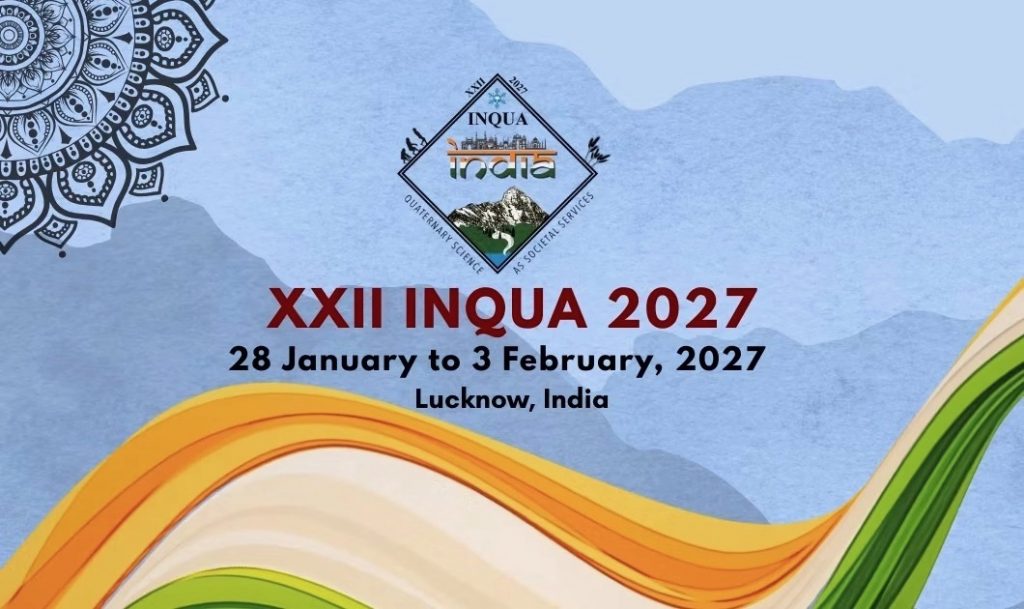
The INQUA Congress, held once every 4 years, is an extremely important venue for all Quaternarists to share their research and ideas. The next INQUA session is in Lucknow, India, January 28 to February 3, 2027. See:https://www.inquaindia2027.in/
An entire theme is devoted to the Anthropocene, and we have a special session on:
The Anthropocene epoch: geology, the Earth system, and relevance to society (Conveners: Martin J. Head, Jan Zalasiewicz, Colin N. Waters, Simon Turner)
Please consider submitting an abstract to this special session. The deadline is 15 February, 2026

The STRATI2026 Congress, the 5th International Congress on Stratigraphy, will be held in Suzhou, China, from June 28 to July 3, 2026 – a historic occasion as it is the first time this prestigious congress is held outside Europe. The congress serves as a pivotal platform for global stratigraphic research, and the Anthropocene is undoubtedly a core focus that aligns perfectly with the congress’s mission of addressing planetary-scale challenges.
We have organized an AWG-sponsored session at the congress: G8. “Late Holocene to Anthropocene Transformations”. This session is dedicated to showcasing the latest research advances in the Anthropocene.
Recent Publications
-
Science or Strategy? The rejection of the Anthropocene epoch demands transparency
Schäfer, G. N., Renn, J., Rosol, C., & Büttner, J. (2026). Earth’s Future, 14, e2025EF007638. Open Access https://doi.org/10.1029/2025EF007638
-
The Anthropocene was rejected as a geological epoch – but the idea is still changing how we see the world
Zalasiewicz, J., Waters, C.W. & Head, M. The Conversation, September 9, 2026, https://doi.org/10.64628/AB.tvq7d9f53
-
Future directions for Anthropocene research and its applications
Zalasiewicz, J., Thomas, J.A., Cohen, K.M. et al. Nat Rev Earth Environ 7, 633–646 (2026). https://doi.org/10.1038/s43017-026-00820-z
Full text access, SharedIt link: https://rdcu.be/7cPLEVr359Za -
Defining the Anthropocene using precise geological evidence
Waters, C.N., Zalasiewicz, J., Turner, S.D. et al. Nat Rev Earth Environ 7, 612–632 (2026). https://doi.org/10.1038/s43017-026-00817-8
Full text access, SharedIt link: https://rdcu.be/cjbbG8pizHCa -
Stories and science: two roles for palaeontology in the Anthropocene
Williams, M., Zalasiewicz, J.A., Waters, C.N., Petrovskii, S., Whitehead, H. and Wong Hearing, T.W., 2026. Stories and science: two roles for palaeontology in the Anthropocene. Philosophical Transactions of the Royal Society B: Biological Sciences, 381 (1942). https://doi.org/10.1098/rstb.2024.0433
-
The new Anthropocene biosphere
Barnosky, A. and Hadly, E., 2026. The new Anthropocene biosphere. Philosophical Transactions of the Royal Society B: Biological Sciences, 381 (1942). https://doi.org/10.1098/rstb.2024.0428
Other Curated Papers
- The Anthropocene debateNat Rev Earth Environ 7, 563–564 (2026). https://doi.org/10.1038/s43017-026-00829-4Open access, SharedIt link: https://rdcu.be/3MGiq8zprMBa “In 2024, geologists rejected the Anthropocene as a new epoch amid dispute over the definition of the term. This Focus issue and online Collection bring together opinion pieces on the renewed Anthropocene debate”.
- On Unease and Discomfort About the AnthropoceneStange, U. (2026). Earth’s Future, 14, e2025EF007489. https://doi.org/10.1029/2025EF007489
- Why the Anthropocene Epoch is a more pertinent concept than the Anthropocene event for understanding ongoing Earth system transition.Chakraborty, A. (2024). Why the Anthropocene Epoch is a more pertinent concept than the Anthropocene event for understanding ongoing Earth system transition. The Anthropocene Review, 12(1), 118-128. https://doi.org/10.1177/20530196241270665